
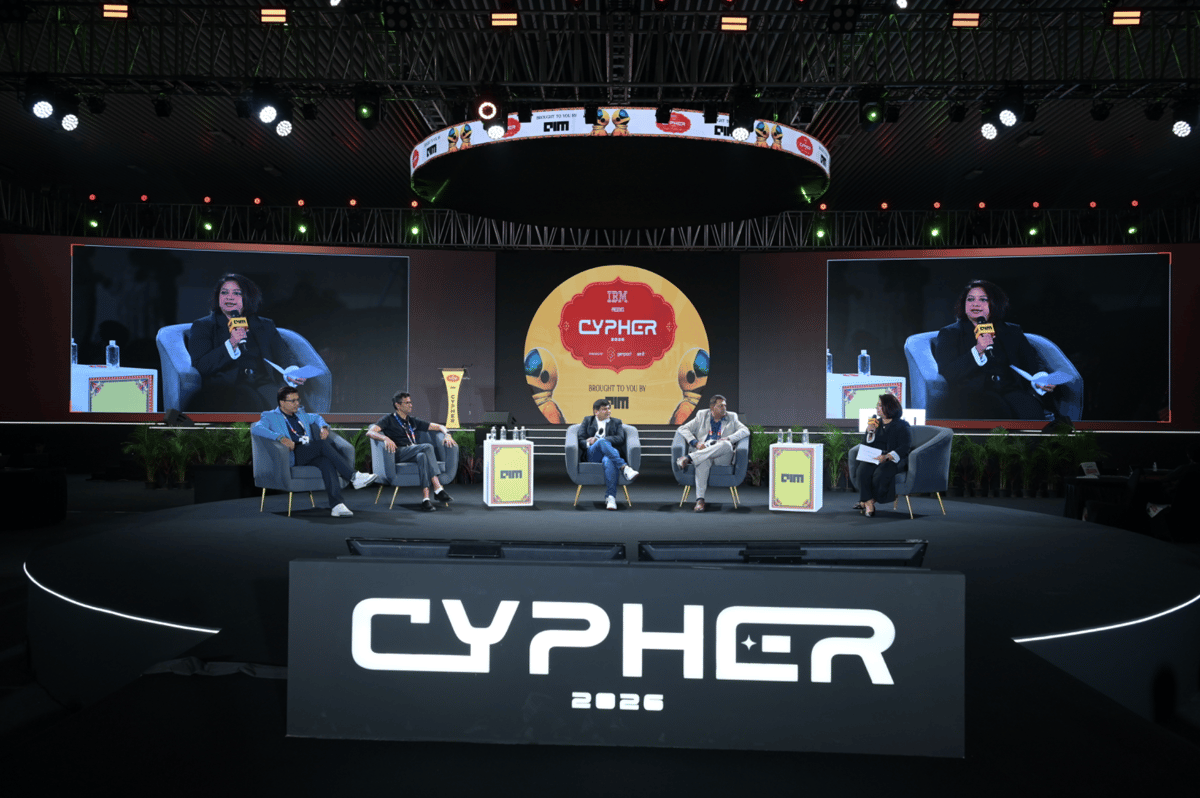

The third day of Cypher 2026 in Bengaluru, the 10th edition of AIM’s flagship AI conference, focused on enterprise model development and the challenges of deploying AI agents in production.
Pratyush Kumar, co-founder of Sarvam AI, opened the day with a keynote on how enterprises can move beyond access to AI models and develop capabilities tailored to their businesses.
He argued that advances in frontier models have lowered the barriers to building AI applications compared with three or four years ago.
Kumar said Sarvam offers infrastructure that allows enterprises to train their own models. “You just bring your environment. 30 lines of Python code and you'll get a checkpoint along with the inferencing script,” he said, adding that hosting open models using rented or purchased GPUs could reduce costs by four to 10 times.
Kumar also highlighted governance as a significant expense in enterprise AI adoption. “I think for every dollar spent on AI, at least a dollar will be spent on governance because it's that important,” he said.
He cited Sarvam's work with the Odisha government to digitise land records. The documents contain printed text, handwriting, strike-offs and annotations over existing entries, making them difficult to process using conventional optical character recognition (OCR).
According to Kumar, Sarvam built a 4-billion-parameter OCR model from scratch for the project. He said its accuracy on the records had improved from about 30% to more than 60%. Government staff correct the model's output, with those corrections fed back into training. Kumar said the project, which he estimated could otherwise take 10 years, is intended to be completed in two.
NeuroDx Previews Sphota Architecture
Dr Siddharth Panwar, CEO NeuroDx, and an Assistant Professor at IIT Mandi, introduced Sphota, a model architecture he said differs from conventional token-by-token processing.
According to the professor, most current language models build their understanding as they process successive tokens. Sphota instead maintains a compact representation of an event and updates that state when the underlying information changes.
In a comparison involving a 600-million-parameter model, NeuroDx said Sphota required substantially less memory for the key-value cache, which stores context during inference.
Panwar cautioned that the figures were preliminary and not from an official release. He said the company planned to emerge from stealth in the coming months and release a model later this year.
Enterprise Leaders Debate Agent Governance
Meanwhile, a panel moderated by journalist Faye D'Souza examined how AI agents could change customer relationships, decision-making and accountability. The discussion featured executives from EPAM Systems, Gulf Oil India, Axtria and EXL.
Using healthcare as an example, Sateesh Gottumukkala, Director of AI and Data Science at EPAM Systems, said an agent could remind a patient to refill a prescription, but a proposed change in treatment would require a physician's involvement.
He also argued that safeguards must be built into system design rather than relying solely on model instructions. An invoice containing a command to ignore previous instructions and process a payment, for instance, must be treated as data rather than an instruction.
Ketan Lodaya, Chief Digital and Information Officer at Gulf Oil India, said enterprises must define decision rights for each task. An agent could identify suppliers, draft contracts and highlight favourable clauses, but signing the document should remain a human decision.
Manish Mittal, Managing Principal and Country Head for India at Axtria, raised concerns about automated decisions that benefit an organisation but harm individuals, including lending and insurance decisions. He proposed the idea of an ethics API that regulators could mandate for certain models.
Vikram Singh, Senior Vice President for Healthcare AI and Analytics at EXL, discussed using AI to answer routine post-surgery questions, allowing surgeons to focus on complex cases. He also cited India's national tuberculosis programme, where patients can text a code printed on medication packaging to report adherence without internet access.
Singh said enterprises should direct some savings from cheaper AI towards monitoring, testing and redundancy.
Temporal Demonstrates Agent Recovery
Shubham Londhe, Senior Developer Advocate at Temporal Technologies, demonstrated how an AI agent could recover from failures during execution. It addressed a practical challenge for enterprises deploying agents: recovering from interruptions while preserving completed work.
He explained that restarting an entire process can cause an agent to repeat language-model calls, increasing token consumption and costs. Temporal records completed workflow steps, allowing execution to resume from the last recorded activity rather than repeating the entire sequence.
Using an agent built with Strands Agents, Londhe simulated a network outage and failures involving model and tool calls. The agent retried its operations and continued after connections became available. “It did not restart. It resumed,” Londhe said.
Day 3 wrapped up the conference on a high note, driven by focused interactions and key sponsor sessions. Gold Partners Okta and LTM took center stage to share expert industry perspectives, while Silver Partner Axtria provided valuable domain insights. Their collective support brought the three-day event to a successful close.
- AI Can Be Cyborg or Centaur. But Can Enterprises Monetise It?
- AMD’s Server CPU Business Faces a New AI Boom
- How an Engineer Is Using AI to Bridge the Accessible Education Gap
- AI Agents are Making Human Customer Service a Specialist Job
- Why Nandan Nilekani-Backed F2A Believes India's Investment Opportunity Lies in Edge AI
- India Needs to Build the AI 'Brain' for Robotics, Not Just Import Hardware